Epilepsy Strikes Back
Epilepsy Strikes Back: The Saga I Most Certainly Didn’t Ask For
This past winter & early spring have brought a mix of growth, setbacks, and a return of symptoms I hadn’t experienced in nearly a decade. This post is both a life update and a deeper look at what it means to navigate disability, healthcare, and work in real time. Read my reflection below, and also what we have to look forward to in the coming months!
What I’ve Been Working On
The last time I updated my blog, I had just done my first-ever art gallery in September. If you didn’t get to attend, you can still check out my virtual gallery here! Since then, I have opened up mini photo sessions on film, created an anti-social media page on my website to avoid traditional social media platforms, done several weddings and other film photoshoots, updated several other aspects of my website, including my recent work on film, and began doing a rebrand (coming soon!).
October: Epilepsy Strikes Back
In late October, I woke up one morning and had an aura, which is a focal aware seizure. In my personal experience, auras typically serve as a warning sign before more intense, tonic-clonic (convulsing) seizures. Just as I looked at the clock and the aura made its way to my head, it stopped. This was the first time I had ever experienced an aura that didn’t lead to a focal aware bilateral tonic-clonic seizure. I was shocked, disoriented, and confused. Was that really an aura? It had been years. I took my seizure rescue medication just to be certain, and contacted my doctors. I didn’t really want to believe what had happened, even though it was unmistakable that I had an aura.
What a Seizure Aura Feels Like
For me, my aura is what I’ve always described as “a blanket of numbness.” You know when you pull a blanket up from your feet, you drag it up along your body toward your head? Imagine that, but pure numbness. Not like pins and needles, but instead, its as though your limbs no longer exist. This happens very quickly, spreading up my body extremely fast, allowing me no more than a few seconds to register what’s happening and try to prepare myself for what’s next. For example, take my second-to-last seizure nine years ago – I was in the shower when the blanket started to grab hold of me. I hadn’t had one in years, yet the feeling is so distinct that I immediately thought, “holy fuck this is happening,” as my toes and feet began disappearing. I had just enough time to turn the water off and try to sit down, but before I could even sit, I fell backwards and started seizing. During the October aura, I used the few seconds I had to try to check the time, as there was no one in the room with me and I couldn’t call out. The numbness takes over so quickly that I lose my ability to speak.
Managing Epilepsy in Real Time
The reason for wanting to check the time is that after the seizure, I could analyze how long the episode was. For those of you unfamiliar with epilepsy, a seizure lasting longer than 5 minutes is a medical emergency, and 911 should be called immediately, as this can result in permanent brain damage. My seizures have only ever lasted between about 1 - 2 minutes, but I wanted to be able to accurately report what happened because time seems to disappear entirely during my seizures.
Fun Fact & Medical Sidenote For Those Interested:
Recently, I found out this “blanket of numbness” sensation is actually called a Jacksonian March. I have focal aware somatosensory seizures with homuncular spread, rapid secondary generalization, and motor arrest. This means I have a complex seizure starting in the sensory cortex that quickly involves the whole brain, often causing a "Jacksonian march" of symptoms, spreading from one part of the body to the next. While the seizure begins with awareness (a focal aware seizure or "aura"), the rapid evolution causes a "focal-to-bilateral tonic-clonic" seizure. This was formerly called secondary generalization and a grand mal seizure, but the terminology has since changed since my original diagnosis at age 12. I’ll break it down a little more:
Somatosensory Focus: My seizures likely originate in the postcentral gyrus (primary somatosensory cortex) of the left frontal parietal lobe, which can produce sensory symptoms such as tingling, numbness, pain, or electric-shock sensations on one side of the body. This is likely caused by the fact that when I was born, I had a left-frontal lobe stroke. The injury to my brain basically makes that part extra sensitive, excitable, and more easily susceptible to neurons misfiring around that area. Learn more about focal onset seizures from epilepsy.com.
Homuncular Spread, also known as a Jacksonian March, or better yet, my “blanket of numbness”: Sensory symptoms (numbness for me), and subsequently motor symptoms (jerking), spread sequentially along the body map (homunculus). Basically, the irritation around my brain injury is close to the brain’s body map. A cortical homunculus is a distorted representation of the human body, based on a neurological "map" of the areas and portions of the human brain dedicated to processing motor functions, and/or sensory functions, for different parts of the body. If you’d like to learn more this and explore some very cool information about the historical context of these seizures, check out this article published in 2011 (updated in 2024).
Motor Arrest: The person may "freeze," lose voluntary motor control, or exhibit an inability to move or speak.
Rapid Secondary Generalization: The seizure swiftly spreads across both hemispheres of the brain, leading to a loss of consciousness and a bilateral (both sides of the body) tonic-clonic (convulsive) seizure. Learn more about generalized seizures from the NIH.
Preserved Consciousness: Despite the focal discharge and inability to control my body, I remain awake, alert, and aware. For me, my first ever seizure started with consciousness, and then I lost it. I was in and out of consciousness for what felt like 5 hours, but in reality, it was only about 2 minutes. Now that I am medicated, I stay conscious the whole time, but I cannot move, speak, or feel anything. Despite my inability to feel, I can see myself convulsing and sense what's almost like a heartbeat throughout my entire body, without truly “feeling it.” It’s an extremely strange sensation unlike anything else I’ve ever experienced and is hard to describe in words.
November
Navigating the Unknown
I had my blood levels checked to see if my seizure medication, Lamictal XR, was still effective, and my levels were lower than in the past. This prompted a review of all my medications and supplements, where we realized that turmeric and ginger—long-standing entries in my chart and individually suggested and approved by my doctors—could potentially affect the metabolism of Lamictal XR. I found this frustrating, as I’ve always been extremely diligent in communicating everything I take to all my providers, including my 10 specialists. All of my providers had previously okayed the supplements, even encouraging me to take them for pain and inflammation, which they did help with. This experience reinforces why it’s crucial to discuss any new medications or supplements with your medical team while also doing your own research. Gaps in the system exist, and sometimes things slip through the cracks.
Another Side Note: The American Healthcare System
Anytime one provider suggests a new medication or supplement, I have to check with all my other healthcare providers before starting. This is, unfortunately, due to the siloed American healthcare system. Research and medical training often focus on one part of the body, rather than the systemic effects. Patients with chronic conditions like cerebral palsy or epilepsy often see multiple specialists instead of a single provider who understands how the condition affects the whole body. Cerebral palsy can contribute to epilepsy, gastrointestinal issues, vasovagal events, depression, anxiety, vision and sensory impairment, orthopedic challenges, respiratory issues, and more; yet adult cerebral palsy specialists are extremely rare. Instead, you end up with a team of providers who each operate within their own lane, which is a systemic issue, not an individual fault.
Changes in Medication
Although I knew going off the supplements likely meant that I'd have increased pain and inflammation again, I stopped taking them because truly nothing is scarier to me than having a seizure. Even with stopping the supplements, my seizure medication levels were still too low. It's no surprise that after nearly two decades, my body is metabolizing things differently, but still scary and a bit discouraging. My doctor suggested increasing my daily dosage, as well as splitting my previously once-a-day dosage to half in the morning, and half at night for a more controlled, even level of medication throughout the day; so I did.
December: Epilepsy Strikes Back, Harder
In December, I photographed two beautiful weddings and a styled shoot with Nadia’s Beauty Spot on film! See my film wedding photos of Andrew & Patricia in Guilford, CT, and Luca & Valentina’s beautiful library wedding on film in Branford, CT, shot on 35mm, 120 medium format, and Polaroid film!
Christmas Day
On Christmas Day, I got an unexpected present (if you can call it that): my first tonic-clonic seizure in 9 years. My seizures have consistently been linked to my menstrual cycle, and sure enough, while on my period, I woke up and had a seizure. I was extraordinarily lucky to have been in bed with my boyfriend, Michael, right next to me, but it was still a terrifying experience.
I’ve never had clustered seizures before (meaning one right after another), but as soon as my seizure stopped, I felt another one starting and grabbed my rescue meds as fast as I possibly could and shoved them in my mouth. My rescue med (Ativan) can dissolve in the mouth, but it is a gamble to have anything in your mouth because of the choking hazard during a seizure (aka, I don’t recommend doing that at all). Not knowing if I had enough time to take my morning dose of seizure medication, I tried to swallow them as quickly as possible and was lucky to swallow them before anything progressed. The meds kicked in, and my second aura stopped.
After breathing for a few seconds to process what had happened, I immediately burst into tears. We all know we have limited control over things in our lives, but the thing I find the scariest is when I completely lose control of my body. My human flesh sack of skin is always a bit on the fritz and hard to work with, but losing control completely is a different ball game. As I write this, my heart began to race thinking about it. I was so lucky to be somewhere safe, but now my safe space is a bit tainted. I’m incredibly lucky that my epilepsy is well controlled, because for some people, this is a daily, or even multiple-times-a-day occurrence. How grateful I should be does not escape me, but it’s still a lot to manage.
The Aftermath
After a seizure, because of the electrical impulses that go haywire, word recall and communication can be much more difficult than usual. I become forgetful, disoriented, and frustrated that I can’t remember very basic things. In my post about COVID brain fog feeling similar to post-seizure I wrote “After having a grand mal (now called tonic clonic) seizure, basic words can become elusive to me. I can visualize them, yet they remain just out of reach—simple words like "for" and “to” slip right through my metaphorical fingers, leaving me grappling with silence. For those who may not have experienced a seizure but have had COVID-related brain fog, you may understand that frustration. The two days following a seizure are particularly challenging, with my body feeling like I got hit by a tractor-trailer, but the effects can linger for up to a month.” It’s kind of like getting hit over the head with a bat…not particularly fun. The seizure I had on Christmas was luckily much milder than my past seizure in the shower, where I also got hurt from falling; so I wasn’t in much physical pain other than a bad migraine, but my memory and ability to communicate were still off for about 4 weeks — the first 2 weeks being the most prevalent.
Since this event, I’ve had several more auras without a full seizure, but I’m currently working with my neurologist, primary care provider, and sleep specialist to try to figure out what's going on and how to get everything under control. Sleep, stress, and my menstrual cycle are the three biggest triggers for me, and I’ve been dealing with far more stress at baseline than in the past, as I’m sure most of you can relate to with the current political climate. I have delayed sleep phase syndrome, which is a circadian rhythm disorder that makes my body want to fall asleep around 5 am and wake up 12- 1pm, which isn’t exactly convenient if you want to be a functioning member of society. This, plus fragmented sleep and stress, has put my body on higher alert than usual.
Since Christmas, I have created a very large spreadsheet to track my seizure-like activity to see if we can find any patterns or possible triggers so that I can get them under better control. I actually made a blank version that, if you or a loved one has epilepsy, you can save a copy and make your own, as I’ve found it quite helpful thus far. Click here to access the Google Sheets seizure tracker. Please note: if you would like to use the seizure tracker, make a copy for yourself first, then edit your own. I included symptoms that relate to my seizures, which include my menstrual cycle, sleep, cerebral palsy symptoms, etc., so feel free to customize your own copy if some of these are irrelevant to you!
January
Trying to Keep a Business Running
The thing about running your own business is that if you don’t work, you don't get paid. There is no sick time, there is no vacation, so all while trying to manage my body freaking out, I had to catch up on work and try to continue business as usual. I still had to edit photos from two weddings from December, and even did a Valentine’s Day couples photoshoot for my mom’s on 35mm and 120 medium format film!
I share this all on my Disability & Art Blog for a few reasons – if you have epilepsy, I see you. It’s scary and I wouldn’t wish it on anyone. If you are a blog reader simply interested in my art, I share to give perspective on what it’s like to juggle disabilities (even though epilepsy is the biggest one acting up right now, I’m still in chronic pain on a daily basis from my cerebral palsy and endometriosis) and trying to manage staying healthy, doing my exercises, going to at least 3 different doctors appointments a week, and managing a business. I am a photographer, but I’m also my own marketing agent, social media manager, content creator, graphic designer, sales manager, accountant, website editor, author, copy writer & editor, UX designer, and more — just to keep my business afloat.
Why Disabled Labor Is Different
I feel that disabled people are inherently hard workers because we have to be. We live in a system that's not designed for us to survive, let alone thrive or exceed. To make matters worse, as of late, there has been a larger issue of disability and minority erasure in the United States. Disabled people statistically spend $1 out of every $5 on medical-related expenses, have higher out-of-pocket expenses than able-bodied people, and yet, our bodies make it indisputably harder for us to do the work needed to make money. So, with the way our current system is set up, you work more, you make more (supposedly, but that’s a whole other conversation), however, when you are already working at your mass capacity, which isn’t as much as the average abled-bodied person, yet you have higher expenses than an able-bodied person, you’re basically doomed from the start. It results in life feeling like the ultimate Sisyphean task – constantly pushing a boulder up the mountain, just for it to roll back down – while having disabilities that make it hard to even move the boulder to begin with.
Unseen Labor
There are several other aspects of disabled labor that are unseen too. It becomes a full-time laborious job to constantly research, communicate, and advocate for our basic needs and human rights in a system that is currently cutting the resources we need to exist. Appointments are booking out months ahead because hospitals and doctors’ offices are understaffed, so even when it’s an emergency, you still can’t get the care you need. After having a seizure in December for the first time in 9 years, scared, quite literally shaken, and disoriented, I was told the soonest I could be seen was July. Luckily, I was able to get on a cancellation list, but things like this add so much unnecessary stress to a body that is physically triggered by stress (as I mentioned, stress is a huge contributing factor to seizures).
Insurance (even Medicaid because the Big Beautiful Bill cuts) are denying things like physical and occupational therapy, even though I have lifelong disabilities. This hadn’t been an issue prior to the financial cuts. For me, this means I then need to talk to my doctor again and argue with insurance. I’ve had medication changes and insurance won’t fill them because they said I received my meds already, even though it is no longer the correct dose. Everything is a fight just to get your most basic necessities to live. This takes time, and energy, when I already have limited energy and am trying to run a business.
Working with Disabilities
Furthermore, you have to figure out how to work around your disabilities. Personally, I’ve learned I need to schedule things with my body, rather than trying to work against it. Because my seizures are often in the morning, and/or around my period, I specifically schedule work in the afternoons, and around my menstrual cycle. This helps me be a reliable worker, even when my body feels unreliable at times. Disabled people are constantly bobbing and weaving challenges on a daily basis, but that's what makes us so resilient. The problem with resilience, though, and the idea that disabled people have to be resilient, is again because we don’t have the things we need, because of the system in which we live. We shouldn’t have to struggle just to get by when being in our bodies is already a struggle in itself.
February & March
Since December, I haven’t legally been able to drive because of my seizures; however, that is about to change! In CT, after you have a seizure, you lose your license for 3 months, for your safety and the safety of others. Having lots of time at home, I was interviewed for the Living My Best Disabled Life Podcast (listen below); managed my epilepsy, buckled down and rebranded (coming soon!). I was also interviewed about the cost of having disabilities for Able News. Read the article here!
The Big Beautiful Bill allowed companies to increase the cost of medication, bringing the cost of my seizure medication from what was already nearly $8000 for a 3 month supply, to now over $19k for the same 3-month supply of my medically necessary brand-name-only med. Check out my art piece about the cost of medicine in America here, as I have a lot of thoughts about that.
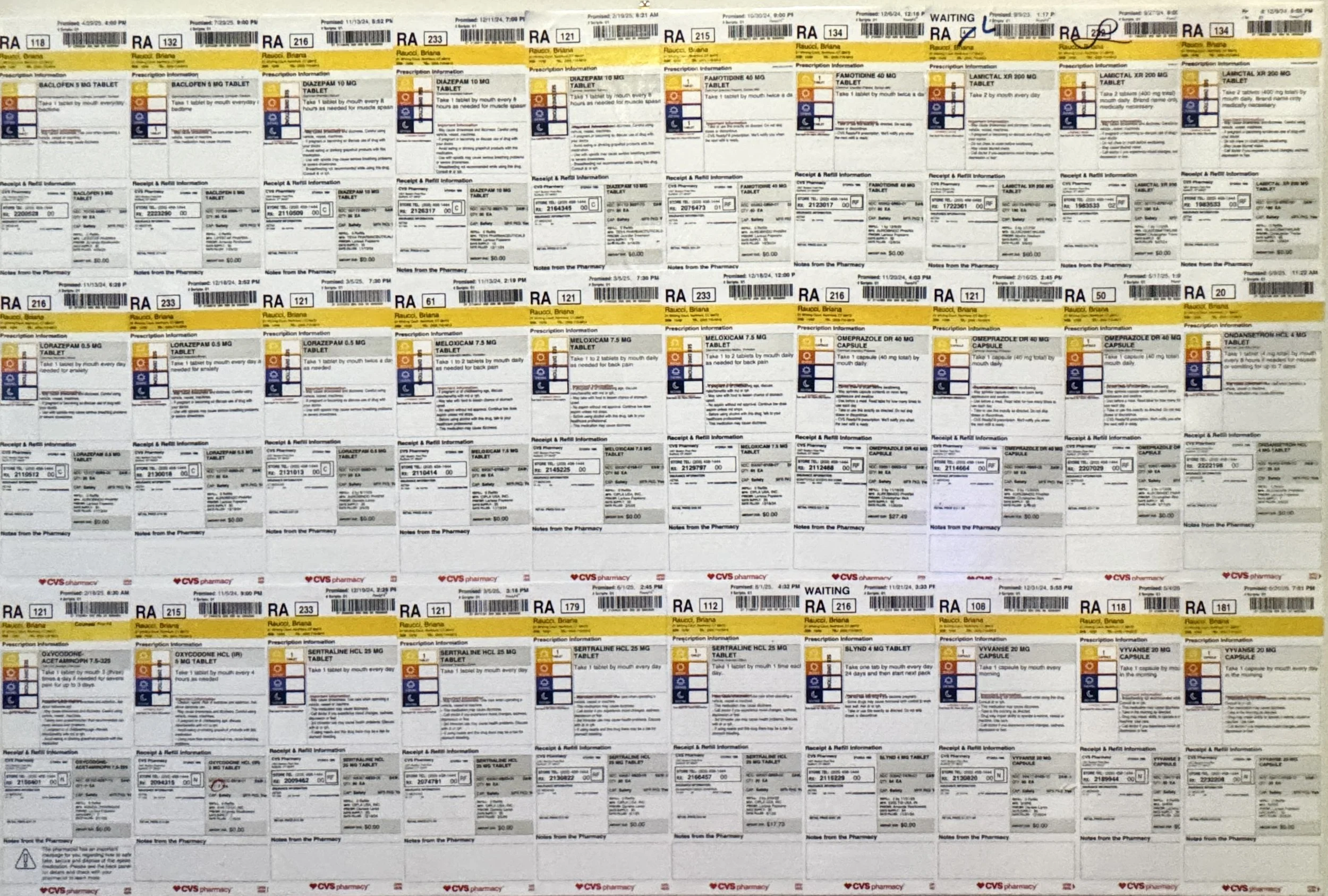
The Cost of Being Disabled in America / $25,168.60 of Meds (Plus $ 7,074.75 More), 2025
Prescription Collage on Canvas, 24x36 inches. Read more about this piece on my virtual gallery.
Luckily, I got some reprieve from the cold early March to visit Michael's parents in Florida. Unfortunately, I didn’t wear a mask on the plane, and ended up getting extremely sick for 2 weeks. I tested negative for both COVID and the flu, and was told it was likely RSV or hMPV. I’ll be honest, I hate flying, so I may or may not have drank and simply forgot to wear a mask, (whoopsies) and by the time I heard other passengers coughing, it was too late. I’m still a big proponent of masking up for travel if you are sick, and to protect yourself and others, I just didn’t take my own advice lol.
March was also Cerebral Palsy Awareness Month, Endometriosis Awareness Month, and Women’s History Month! Each of these causes are deeply personal to me and have shaped my experiences, challenges, and the work I create. Read more about these conditions from my previous articles, as they are still relevant.
The World (& My Body) in Chaos
Despite every curveball my body throws at me, despite the number of doctors appointments I have an how much time that eats up out of my week (8 hours on average, which is an entire work day), despite colds and viruses, despite having political unrest and traumatic events happening not just in our country but worldwide, I still gotta work. I still have to keep going, and it doesn’t feel normal. It doesn’t feel sustainable, and I don’t think I’m alone with that feeling. Every day I have to open my social media to post and try to advertise my work and am immediately inundated with people being shot in broad daylight, wars across the globe, genocide, children starving, global warming, unprecedented storms and basic human rights being challenged, activley ignored, and stripped away.
Why I Still Write
With everything happening with my own body, as well as externally in the world, it’s been hard to keep up with the blog, but it’s not for lack of trying. There’s so much injustice happening in the world today, and we’re all seeing it happen in real time. The wealthy, authoritarian oligarchy that is composed of major corporations, monopolies of all our media and resources, is scrambling to scare us because they’re scared. The rich and powerful fear when the public wants to hold them accountable for their fair share. We are meant to feel helpless to it all, so we submit and do nothing. We cannot let that happen. The current administration is actively trying to strip away all of our civil rights, our healthcare, and our ability to pursue happiness through attacking our lives and constitutional liberties, all while dismantling our already problematic infrastructure. That being said, they are focused specifically on disadvantaged and disenfranchised groups.
While no administration has protected our most vulnerable populations as well as they should have, this administration is especially determined to rescind the rights of disabled people, women, minority groups, including people of color, the LGBTQ+ community, and basically anyone who’s not a straight white man. They are shuttering research, spreading misinformation, attempting to incite violence, and trying to make us feel helpless to it all. They are starting wars no one asked for, killing innocent people, and creating turmoil globally.
I continue to advocate for a better world for all of us and write about my personal experience on my Disability & Art Blog to try to create more understanding during a time where our government wants to keep us divided and fighting amongst ourselves, rather than fighting the oligarchy that is relentlessly attacking our democracy.
These billionaires, major corporations, and tech companies would rather have us all suffer and argue so they can continue to make money and rule as they please. They will try to make you feel like you have no power to change this or make a positive impact on your community, but this is not true. We must continue to fight for our rights and share our experiences so we can improve the world for everyone.
One Very Fun Thing: Tattoos
Despite everything I’ve mentioned in this now very long update, I have done one positive thing for myself. I’ve gotten some tattoos! In this economy, you may ask? Yes! Why? Because my whole life, I’ve battled to love my body. I’ve felt broken, embarrassed by my limitations, and not confident in my looks due to my disabilities. I’m reclaiming all that through art. I’m making my body a canvas for my friend Cait Coale, a tattooer at Hand of Fate in Tattoo in Meriden, CT. Cait specializes in bold and bright American traditional tattoos and has been tattooing in CT for about a decade — check out her work here! Cait has been helping me build confidence and feel like a pretty princess with her art. We’ve been working in black & grey, but boy, are they bold and beautiful! I’ll write more about them in another blog post, but, for disabled people who can relate to feeling uncomfortable in your own skin – if you’ve ever considered getting a tattoo or want one, I’d definitely recommend going for it! It’s been a great way for me to feel more confident in myself, even when everything else feels off right now.
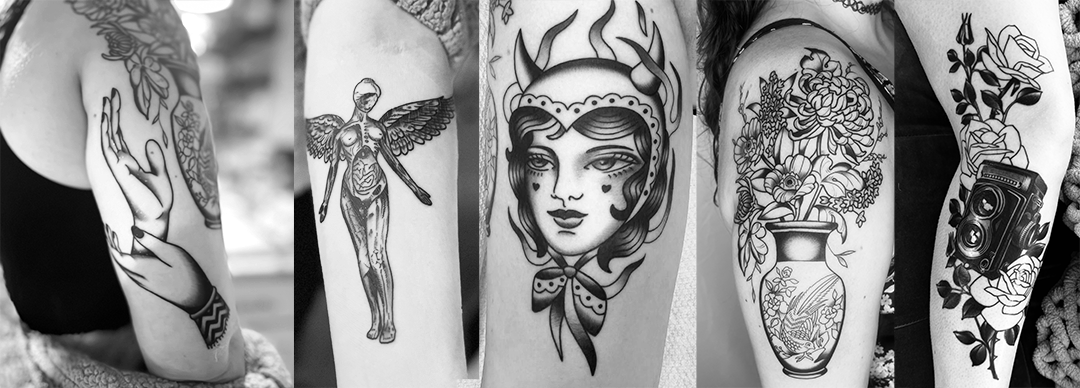
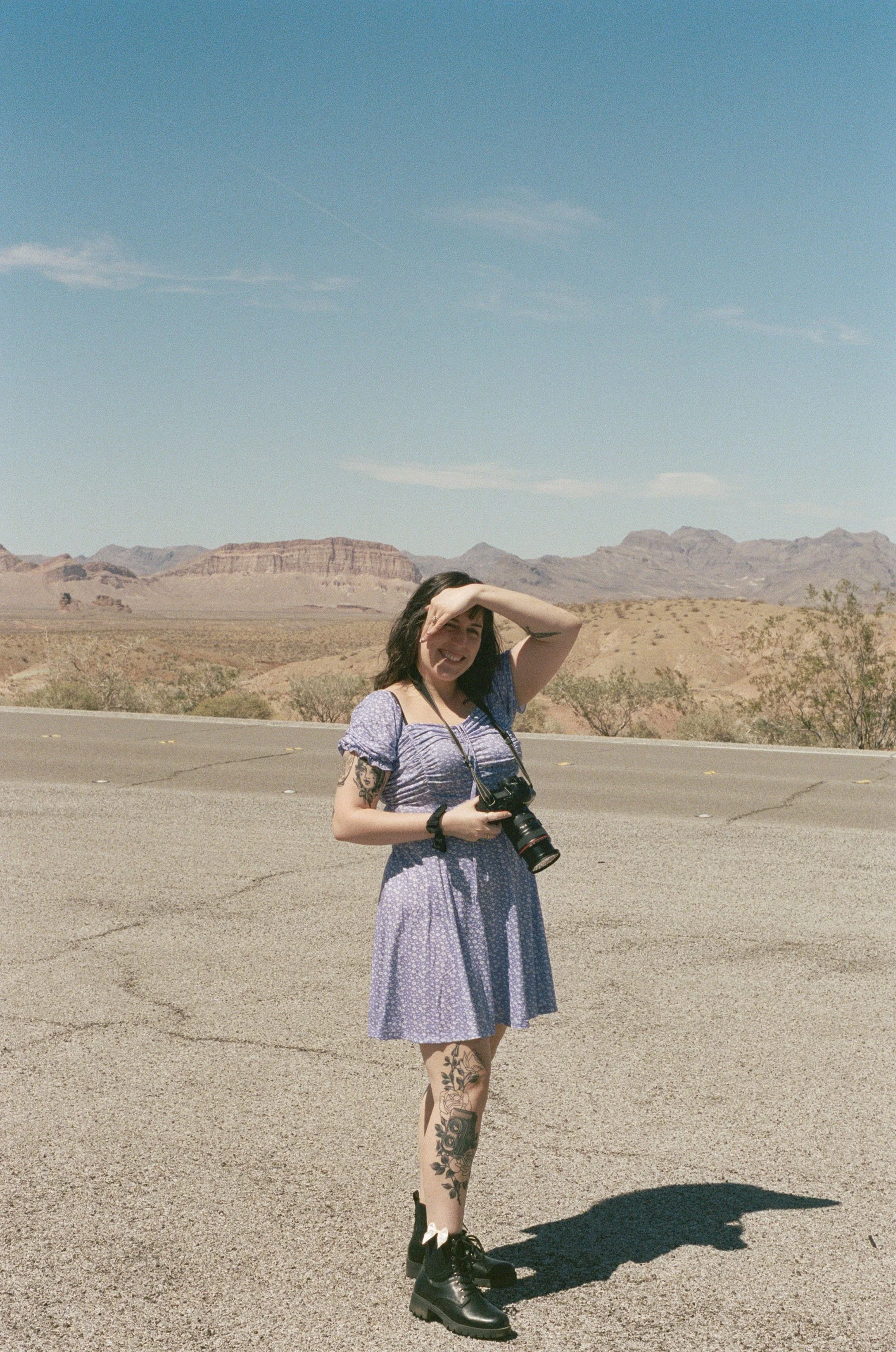
Pictured from left to right: Laura Palmer’s “meanwhile” hands from Twin Peaks on the back of my right arm; Nirvana’s In Utero album artwork of a Transparent Anatomical Manikin on my left forearm; a little Devil lady I’ve named Beatrice (hehe) on my right bicep; a really beautiful vase that my grandfather bought for my grandmother with some of my favorite flowers on my right upper arm; and lastly, a work-in-progress tattoo of my Rolleiflex camera with roses! Not pictured since it’s on the back of my left arm, is a really cool Kurt Vonnegut drawing! Can’t wait to post more updates (and take some more pictures without second-skin) as we go! Thanks, Cait! Go follow Cait on Instagram for more of her amazing work!
April
April is PMDD awareness month. PMDD is a severe, cyclical mood disorder that causes rage, depression, anxiety, and physical symptoms that can take over your life. Read more about PMDD in my blog post from last April and check out my PMDD art!
April marked several other awareness observances I care deeply about, including autism awareness month, occupational therapy month, Medicaid awareness month, stress awareness month, and financial literacy month. While I couldn’t cover all of them in full posts (yet), here’s some information I wanted to share.
Autism Awareness Month: Lately there has been a lot of important conversations (and misinformation) about autism. Learn more about Autism on Autism Speaks.
Occupational Therapy Month: Learn about occupational therapy and how it helps people with disabilities.
Stress Awareness Month: Stress affects everyone. These tips from Mental Health UK can help. Also, check out my PMDD post. Many of those strategies I mentioned apply to daily stress, too.
Financial Literacy Month: ABLE Accounts help disabled people save money without risking Medicaid or SSDI eligibility. They’re tax-free and flexible. Learn more about ABLE accounts through the ABLE National Resource Center.
Medicaid Awareness: Signing up for Medicaid can be a nightmare, but I found out that a local insurance broker can help you register faster than doing it alone. In Connecticut, I got help from Steve Cudgma, who helped me register through AccessHealthCT. For national information, check out the Medicaid Overview, and try calling a local insurance broker if you need assistance!
Looking Forward
With my seizures now better managed with a higher dose of medication, I’m looking forward to the next few months! I have a lot of really exciting photography gigs coming up, including some weddings, engagements, an elopement, a gender affirming shoot, and more! I can’t wait to share more, but there are lots of exciting surprises coming.
GoFundMe
I’d love to keep up with the blog more, and do have more articles coming up, however, this work is all currently unpaid. I’m so very grateful for the contributions I received through my GoFundMe, and thank you again to everyone who donated in the past! To put the funding I raised into perspective, the 2025 minimum wage in CT was $16.35 per hour. With $1,545 raised, you all have graciously funded about 95 hours, or 2.36 weeks of a minimum-wage job in CT! I will continue to work on it in my spare time, always, donations or not, but if you’ve enjoyed the blog and would like to pass it along to family and friends, please do! Every dollar helps me focus on spreading more disability awareness, creating disability-related art, writing, and editing the blog! I’d still love to make the podcast as well, but I need your help! Help spread the word or donate to the GoFundMe here.
Hope for the Future
If you’re interested in the other work I’m doing, check out my recent work on film, and my wedding, engagement, and elopement photography! My biggest hope for this year is that we can all work together to improve the world around us. The beauty of this country is the diversity of people, backgrounds, beliefs, hopes, and dreams. We all have a lot more in common than you think. Don’t let the media tell you otherwise. Now is more important than ever to read up on history, expand your knowledge, and be of service to your community. Remember to be good to your friends, family, and neighbors. Help be a part of the solution by spreading love, peace, and hope for the future.
We have friends everywhere.
If you liked this article, consider making a donation
Hi there! I am an artist & writer with disabilities, and I have been running this Disability & Art Blog unpaid for the past year — sharing personal stories, research, and resources to help others feel seen, informed, and empowered. While I love what I do, I also believe disabled people deserve to be compensated for their time, labor, and expertise. I’m currently crowdfunding to turn this into a sustainable, paid job — one that lets me focus on independent disability journalism, educational content, and artwork that speaks to the real lived experience of being disabled in America.
Help me keep the blog going and expand it into audio & video podcast formats to make it more accessible, engaging, and inclusive. With your help, I can write investigative articles, interview experts, and launch my podcast, Thank You So Much for Asking. Every contribution is meaningful and thoroughly appreciated. Thank you so much for your support! — Sincerely, Briana Raucci
A thank you to my supporters
Thank you to everyone who has donated to my GoFundMe campaign thus far! Your support truly means the world to me. I deeply appreciate that you see the value in this work and that you believe disabled voices, independent journalism, and accessible storytelling are worth funding.
Because of your generosity, I was able to make time to participate in this podcast and write this blog post. That may sound small, but for those of us juggling disability, advocacy, and creative work with limited resources, it’s everything. All the thanks to: Mike & Julia Oriente, Dorothy Vaspasiano, Michael J. Harkey, James Miller, James Mcgee, Vicki Gelpke, Larry Gobel, Wendy Naratil, Taylor Macioci, Judy Petrillo, Stacey DeMartino, Jordyn DeMartino, Maddy Ullman, Joy Panigada, Judith Wilcox, and Lauren Raucci for making this possible!
More articles you may be interested in:

Want more posts like this? Visit my Disability & Art Blog!
